The history of the 1980 city flag of Rochester, Minnesota.
We are all shaped by the past, and the influences of history often play a part in the creation and design of flags. Vexillology (the study of flags) is a relatively new word. It was added to the dictionary in 1959, and comes from the Latin word for flag, vexillum. Vexillography is the art and practice of designing flags.
Flags throughout History
Our view of the past constantly changes as new evidence arises or as old evidence is reinterpreted, and is always closely interwoven with the personality and interaction of the interpreter. The mapping of a pathway in time can be a fascinating adventure, both in finding things and in finding out things – asking not just when and where, but how and why.

For example, this clay tablet discovered in the late 1800’s in Sippar, Iraq, known as the ‘Babylonian Map of the World’ is said to be the oldest map of the world. This small map provides us with a glimpse of the way space was conceived by the ancient world in 600 B.C.
The form and design of flags historically has varied widely. In the passage of time, flags have been used as symbols for nations, organizations and trades. They have been flown by kings, armies and cities, and also used as a means of communication.

From the earliest times of record, standards or banners were borne by nations, and carried in battle. Something which was at hand was seized in an emergency, lifted up as a rallying point for the people, and afterwards adopted from the attachment which clung to it as an object identified with patriotic deeds.
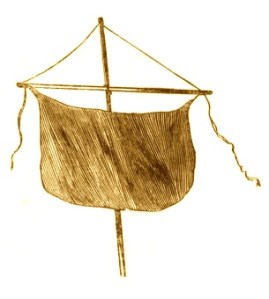
The proper royal standard of the Persians for many centuries was simply a blacksmith’s leather apron, around which the people rallied in opposition against invaders. One of the most ancient of the Roman standards was composed of a wisp of hay attached to the end of a pole and carried into battle. The bronze Shahdad Standard, from Shahdad, Iran is one of the oldest known flags in the world, dating back to about 2400 B.C. or earlier.
It helps when examining the past to do so in the mind-set through which the people of the past viewed the world around them, rather than from a mind-set of present day. Arab scholar and historian Ibn Khaldun (AD 1332-1406) stated in his book Introduction (Muqaddimah – مقدّمة ابن خلدون): “A hidden pitfall in historiography is disregard for the fact that conditions within the nations and races change with the change of periods and the passing of days… Often, someone who has learned a good deal of past history remains unaware of the changes that conditions have undergone. Without a moment’s hesitation, he applies his knowledge (of the present) to the historical information and measures the historical information by the things he has observed with his own eyes, although the difference between the two is great. Consequently, he falls into an abyss of error.”
The Story of the 1980 Rochester City Flag
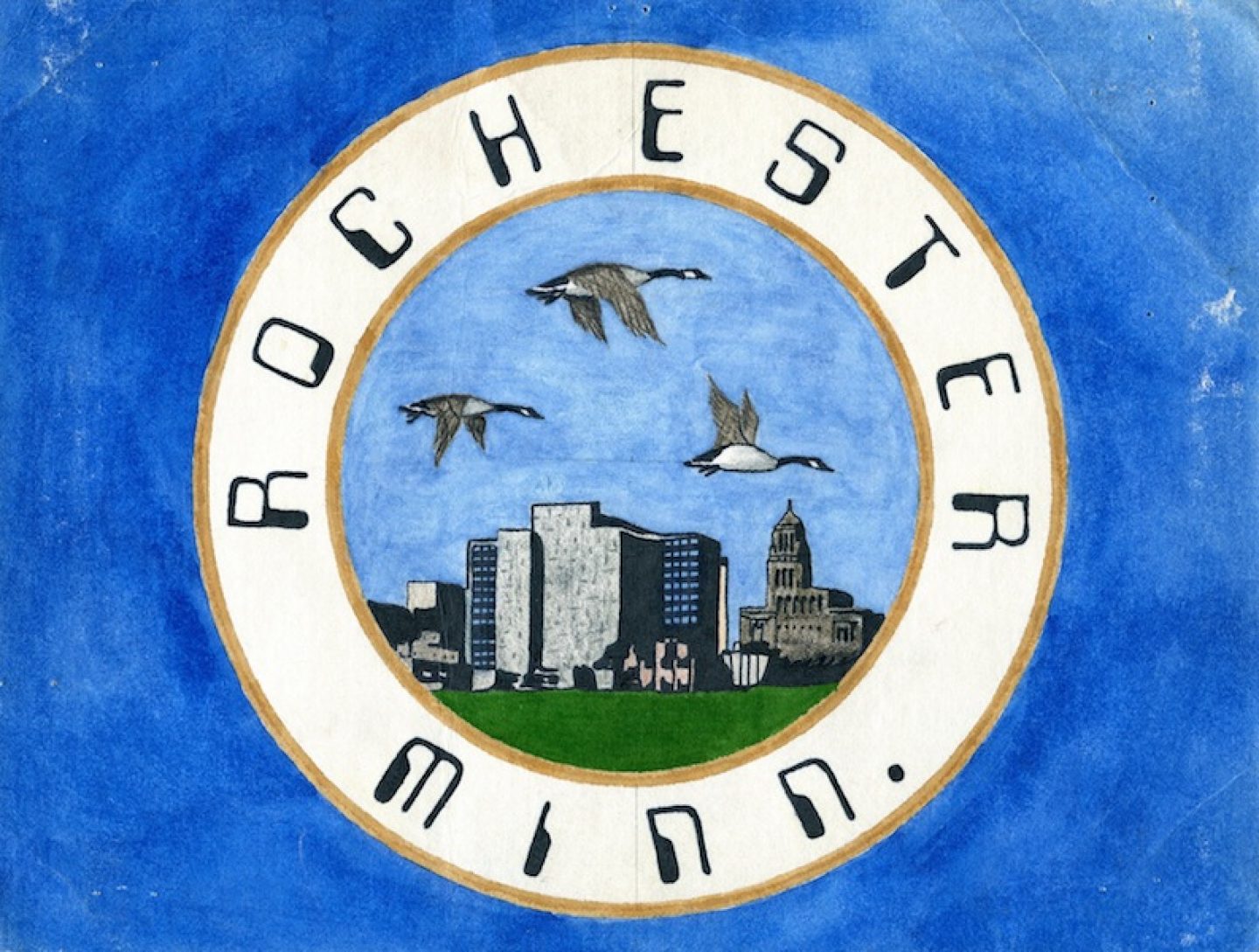
In 1980, the city of Rochester, Minnesota held a city-wide competition for an official city flag design. At the time I had just completed my first year of studies at the Minneapolis College of Art and Design as a student of Fine Arts. Returning home to Rochester for summer break, I decided it would be fun to enter the flag design competition. Nearly 200 flag proposal entries were submitted. Forgetting that I had submitted an entry, it was a surprise to receive the phone call notifying me that my design had been selected for the official city flag by the Rochester City Council at the June 16, 1980 council meeting.

The flag was presented to me on August 19, 1980 by Mayor Chuck Hazama and City Council President Dick Postier, at a ceremony held at the Rochester Public Library in Rochester, Minnesota.
In 1980, the year of the design competition, landline phones were still in use, Commodore released the VIC-20 home computer, and Tim Berners-Lee at the CERN physics laboratory created Enquire, a networked hypertext system seeking to categorize hyperlinks in a way that could be read by computers as well as people. Laptops and smart phones did not exist.
I spent most of my childhood growing up in Rochester, which had an influence on who I am today. One of my main playgrounds was the historic Rochester Public Library, now part of Mayo Medical School, located at 226 2nd Street SW.

This 1937 Jacobean Revival architectural jewel was designed by Harold H. Crawford (1888-1981), a local watercolor artist and architect, and built of Kasota limestone by the Public Works Administration. The building was listed on the National Register of Historic Places on July 2, 1980. As a child with a voracious learning appetite, I spent hours roaming the bookshelves of this library and carting home stacks of books to devour.
Another favorite playground of mine was the Olmsted County Historical Society, along with its pioneer log cabin, which at the time was located just around the block from the Rochester Public Library.  I spent many an afternoon exploring its historical exhibits and displays, and contemplating the stories and objects of Rochester’s history associated with them. I attended elementary through early college years in Rochester, and also took classes at the Rochester Art Center.
Rochester was also the home place of one of International Business Machines’ (IBM) largest manufacturing facilities, designed by AIA Gold Medal architect Eero Saarinen. Rochester is also the home place of the Mayo Clinic and its new Destination Medical Center (DMC) initiative. Soldiers Memorial Field Park was my outdoor playground year round – sledding in winter, and swinging, swimming, bicycling and tennis in summer. A very familiar sound was the honk of the Canada goose overhead.
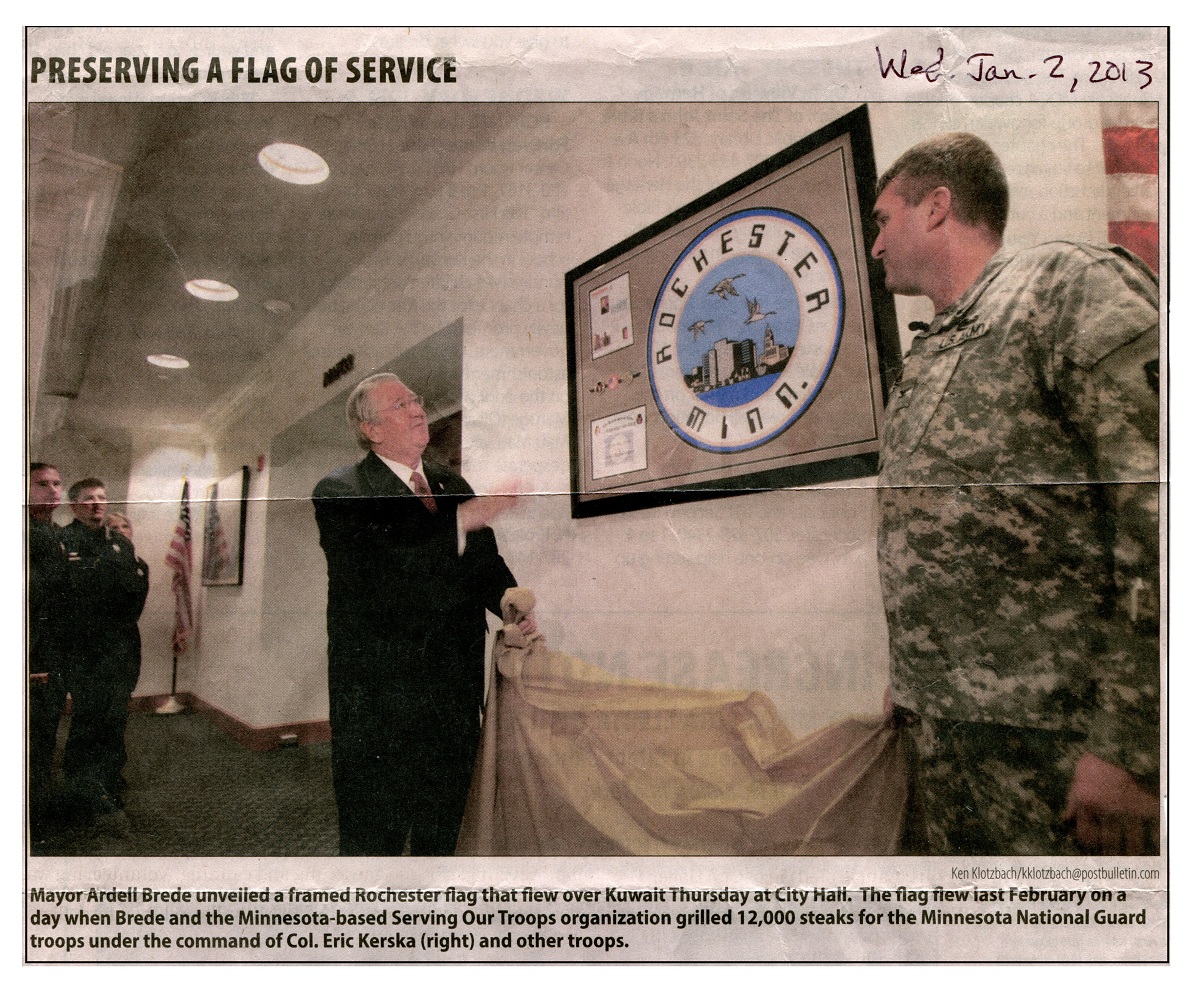 In 2012, the Rochester City Flag flew over Kuwait when Mayor Ardell Brede and the Minnesota-based Serving Our Troops organization grilled 12,000 steaks for the Minnesota National Guard troops under the command of Col. Eric Kerska and other troops. Above the flag is displayed by Mayor Brede at Rochester City Hall.
A flag’s beauty and meaning can be considered in many different ways, such as aesthetically (based on appearance), symbolically, using standards such as the NAVA standards, or any other standard. Flags can also be considered in social, political, historical contexts, which are missing from the NAVA standards.
Members of a community display local flags as a matter of regional pride. It is because of what the flag represents and means to them as a member of their community. Flags are about the human-place association.
My 1980 design for the Rochester City Flag is just that – a 1980 design. Could it use some modernization? Perhaps. If a flag is updated, it should be done by the residents of the community for whom the flag represents.
Laurie A. Muir
January 17, 2018
 Laurie A. Muir artist