The Story of No Name Gallery (1988-2005)
For every artist showing in the Minneapolis commercial gallery district in the 1980’s, there were many interesting emerging artists who were finding it difficult to get their work shown. So in October of 1988, Jim Tittle and I decided to open a gallery called “No Name Gallery” to refer both to the “unknown” artists we planned to show, and to the non-commercial approach of its operation. Jim and I had just moved our art studios from the Harmony building in Minneapolis to the first floor of the Skunk House building located at 100 North First Street in the St. Anthony Falls Historic District.

History of the Skunk House
The building was originally built by Stephen E. Foster, who settled in St. Anthony in 1849. According to his advertisement in the Tribune’s Directory, Foster was the first blacksmith who located at the Falls of St. Anthony. By 1865, he ran a blacksmith shop with James W. Munson in a wood frame building located on the corner of North First Street and Utah Street (now known as First Avenue North).

Around 1868, Foster went into business on his own, and changed with the times by commencing into a manufacturer and dealer in carriage and wagon making.
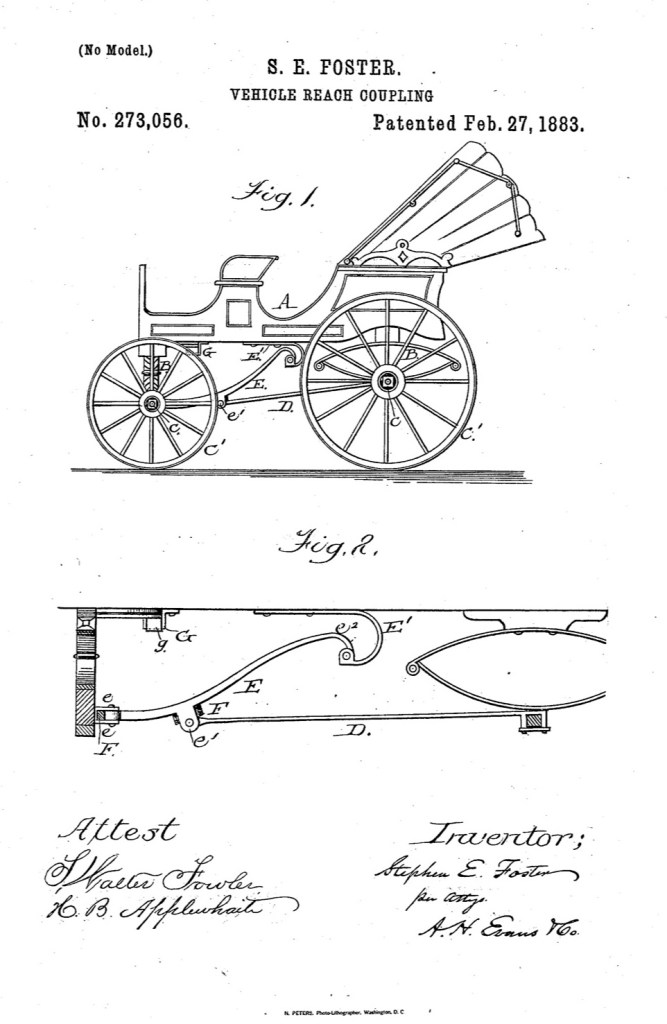
In 1882, he replaced the wooden frame smith works with the three-story brick Italianate-styled building that stands today. In 1884 he converted the store into a 35 room hotel known as the “Foster House” and later added an addition to the back of the building. The Foster House Hotel remained operating until 1903, and then was used for industrial purposes by a succession of firms, including the McMillan Fur and Wool Company, hence the nickname the “Skunk House”. The old Minneapolis Journal reported that heart failure brought death to Stephen E Foster, old time resident, at his 2316 Fremont Avenue S. home in Minneapolis.

When Jim and I moved our art studios into the building in the 1988, it was owned by John J. Linsmayer, a.k.a. “Head Skunk”.
Artists in Minneapolis and Saint Paul have a long history of converting warehouse space into art studios and exhibition space, such as the “The Ranch”, which was a hip collective of U of M artists in the 1970’s who worked and lived together in a warehouse on the corner of Washington Avenue and 11th Street in Minneapolis, and was shut down in the 1980’s. Alternative exhibition spaces play an important role in the local art scene, and as commercial development progresses, the opportunity for emerging artists to explore and exhibit diminishes, hence the importance of alternative art spaces.
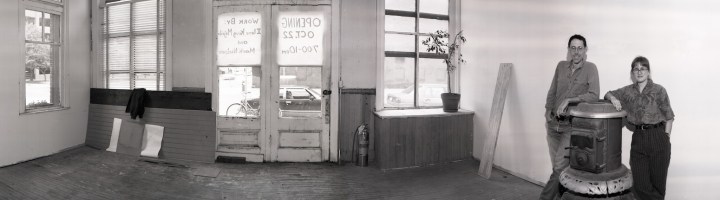
Liz Armstrong, a curator at the Walker Art Center in 1990, visited alternative art spaces as a matter of course, stating that “…because they’re not commercial, it’s likely you’ll find things that are more radical than you’ll see in other galleries.”
The Beginning of No Name Gallery
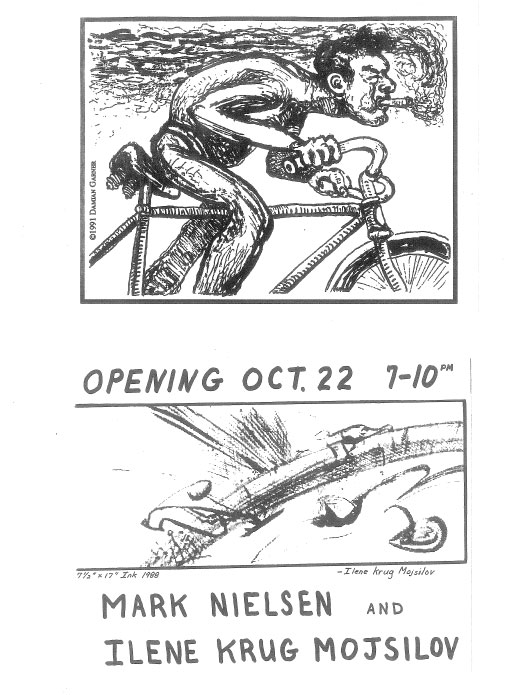
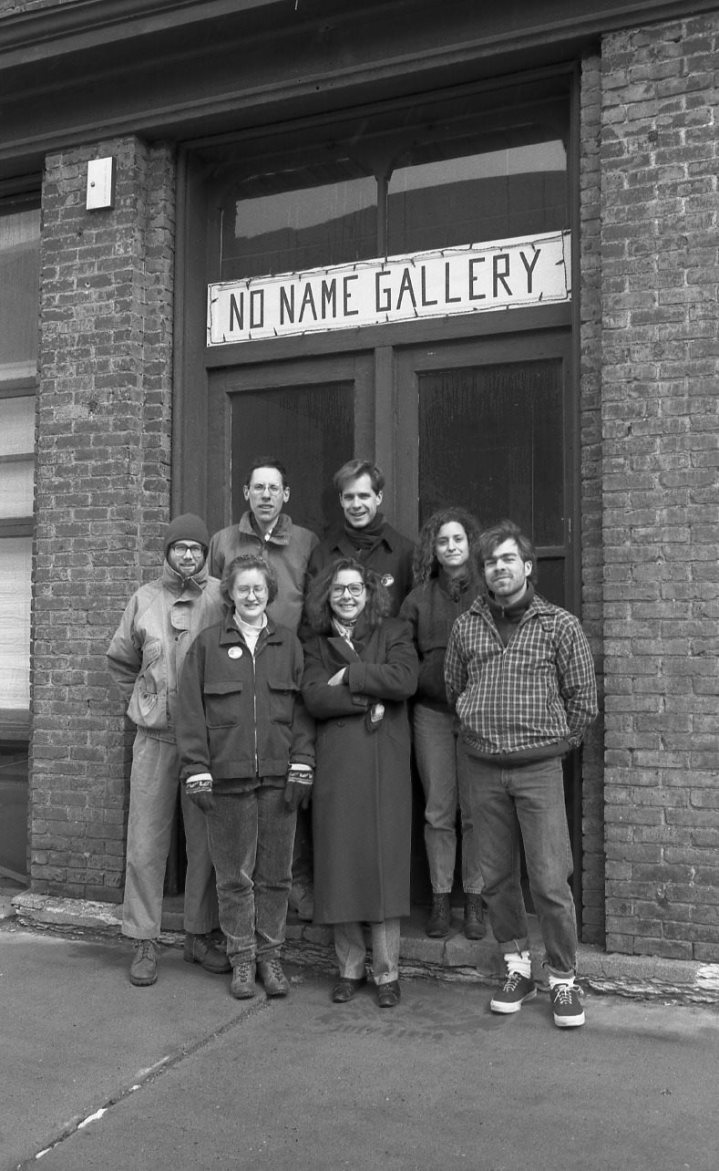
No Name Gallery’s first opening show was held on October 22, 1988, exhibiting the work of artists Susan Abelson, Matthew Smith and Lauren Stringer. Gallery sales went directly to the artists. Jim and I built the space on our own – I worked a full time day job while running the gallery, and the building owner provided the storefront in exchange for work Jim did on the building. The gallery volunteers and artists also contributed talent, paint, light, publicity, time and energy.
The combined efforts of all the gallery volunteers and artists are what made No Name Gallery possible.
The most rewarding part of running the gallery for me was going out and touring artist studios every month, talking to artists about their work, and selecting art to exhibit. The gallery also had guest curators. Each show opening would bring in about two hundred visitors, many stopping by after going through the commercial art gallery crawl in the warehouse district. There was even an art tour that came through regularly. Summit Brewing Company was just getting started at the time as well, and contributed some of its new beer for our art openings.

As an alternative art space, No Name Gallery provided artists with a space in which to experiment and take chances – to explore creatively, and share that artistic exploration with members of the public.
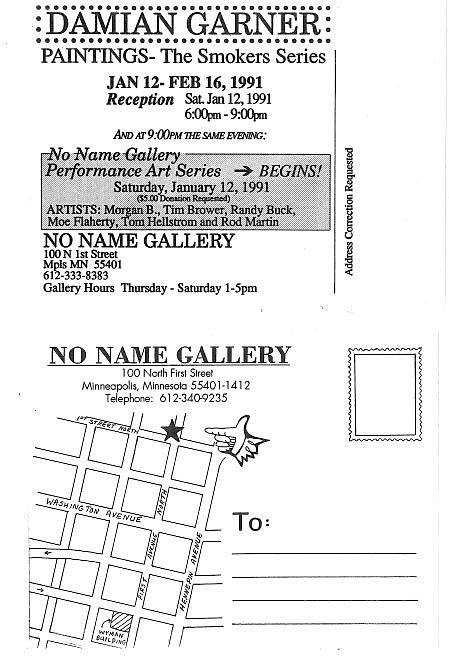
The art work displayed by the gallery ranged from paintings, sculpture, video, sound, light, the spoken word, and art performances.

Jim built a stage in his studio space behind the gallery, and we rented chairs and transformed the space for art performances. The gallery space provided many emerging artists the opportunity to jumpstart their careers.

And yes, quite a bit of the work shown was considered radical – artists pushing the boundaries. There are no limits when it comes to art.
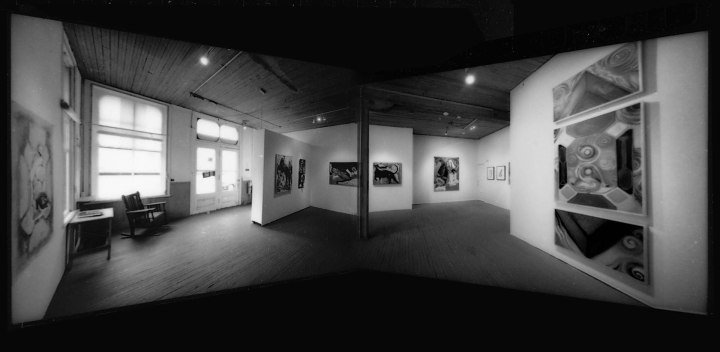
I retired from the gallery in the 1990’s so that as a non-profit organic entity, the gallery could continue to grow and expand through new management.
To celebrate the 20th anniversary of The Soap Factory, curator Andy Sturdevant created The History Room, containing archived material from the twenty-year history of No Name Gallery’s and the The Soap Factory.
“In October of 1988, a new art space calling itself No Name Gallery opened its doors in the Warehouse District of downtown Minneapolis. That gallery would eventually become the Soap Factory, one of the longest-lived contemporary art spaces in the Twin Cities. To celebrate the 20th anniversary of The Soap Factory, curator Andy Sturdevant has created The History Room, a gallery dedicated to telling the saga of Soap from the depths of 20 years of archives. Including photographs, artwork, promotional posters, historic documents, personal recollections and video, the History Room gives visitors an opportunity to learn more about the gallery famed for its raw space, its brutal lack of heat, and its remarkable following of artists who have tirelessly transformed it over the years. The Soap Factory is one of the largest spaces for contemporary art in the Twin Cities, and the exhibition History Room charts not only the story of No Name and The Soap Factory, but also the story of the thriving, exciting, and ever-evolving art scene for which Minneapolis is so renowned.”
Watch the video of the exhibit on YouTube: History Room: 20 Years of No Name and the Soap Factory (2008 Apr 19 – Oct 26) Video by Bob Fagerhaugh.
Listen via YouTube to artists Ilene Krug Mojsilov and Mark Nielsen discuss No Name Gallery at The Soap Factory’s 20th anniversary exhibit.
No Name Gallery continued to operate until 2019 as “The Soap Factory”, a laboratory for artistic experimentation and innovation and the largest independent contemporary art gallery in Minneapolis-Saint Paul, Minnesota. I sincerely hope that others will continue No Name’s legacy and support artistic experimentation, innovation, and emerging artists around the world.
On August 2, 2020, Jim Tittle passed away from Glioblastoma brain cancer. His stories, smiles, and laughter will be missed by so, so many. May he be at peace.
Laurie A. Muir
Other alternative art galleries in the Twin Cities that existed around the time as No Name Gallery:
Artifex Alternative Arts Museum
Haupers-Mairs Gallery
Icebox Gallery
Intermedia Arts
pARTS
Rifle Sport Gallery
Speedboat Gallery
Un Fam Art
Wilensky Arts
 Laurie A. Muir artist